
All articles
Companies Still Hiring for Channel Optimization Are Missing the Cross-Functional Growth Leader They Actually Need
Jeffrey Rufus, Head of Growth at Where's Wade, explains why growth leadership in 2026 is about systems architecture rather than channel optimization, urging CEOs to embrace the friction required to unlock revenue.

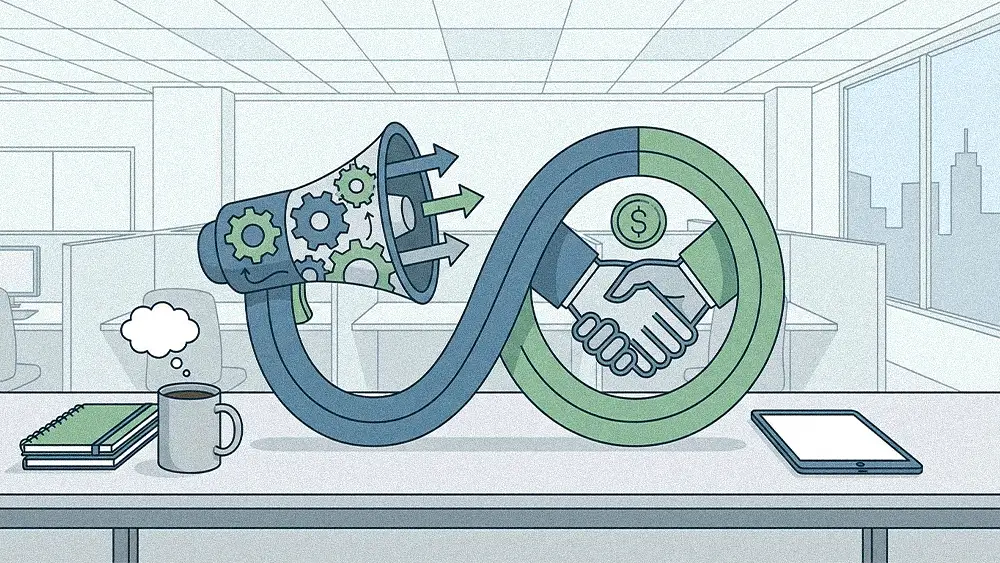
Growth has taken on a very different meaning. It's now about connecting the dots between product, marketing, and sales to unlock revenue, not just optimizing a channel or running more campaigns.

The Head of Growth title appears on hundreds of job postings every quarter. If you look closely at the descriptions, however, the role companies are hiring for in 2026 often reflects a 2024 reality of building channels, optimizing campaigns, and fixing funnel leaks. The problem is that AI has already commoditized most of that work. A single operator with the right tools can automate demand generation, produce content at scale, and run multi-variant campaigns without a team of ten. The execution layer that once defined growth marketing is no longer a differentiator. It's infrastructure. The companies that haven't updated their understanding of what growth leadership actually requires are making hires that are misaligned from day one.
Jeffrey Rufus, Head of Growth at growth studio Where's Wade, specializes in AI transformation for tech and e-commerce companies. His career stacks product, data science, and go-to-market experience, giving him a cross-functional perspective that most vertical leaders lack. Working in a consulting capacity across multiple organizations gives him direct visibility into how companies define, scope, and ultimately misunderstand the growth hire.
"Growth has taken on a very different meaning. It's now about connecting the dots between product, marketing, and sales to unlock revenue, not just optimizing a channel or running more campaigns," he says. "If I can produce a system run by one person, automate everything, and have it running in the background, what does a growth manager actually mean in 2026?" He sees the disconnect playing out repeatedly: companies posting for growth roles that describe optimization work AI has already absorbed.
The Diagnostic Gap
The mismatch goes deeper than job descriptions. Rufus finds that most companies hire for growth reactively, without a clear understanding of why growth stopped in the first place. "Most people do not have a strong hypothesis about why growth is stalling. They know revenue is flat or users are leaving, but if you go to product, the revenue officer, and marketing and ask the same question, they all give different answers." That fragmentation, he says, is the real problem. Each function sees the issue through its own lens and proposes a fix within its own silo. Growth, in Rufus's framing, exists to unify those perspectives, diagnose the systemic issue, and make adjustments across all three functions simultaneously. "When I look at opportunities, what I want is the ability to affect the levers across product, marketing, and sales, not just confirm what one team is already doing."
He uses a mechanical analogy to illustrate why siloed fixes fail. "When you think of a growth operating model, you pull one lever and something else breaks. You turn off a campaign because CAC is rising, and then the sales team says their pipeline is drying up. The incentive structures don't match. Growth should be the unifier that brings it all into harmony."
The Discomfort Factor
Hiring someone who can genuinely operate across product, marketing, and sales means bringing in a person who will inevitably challenge the assumptions each of those functions has already committed to. That's inherently uncomfortable, and Rufus argues it's the reason many organizations can't structurally support the role for a meaningful length of time. "The role requires you to have genuine fluency across product, marketing, and sales, with a view to asking hard questions they may not be positioned to ask of themselves," he explains. "But when you're brought in just to validate what's already being done, that's not growth. Growth is about acknowledging that your hypothesis may have been wrong and changing the way you think about solving the problem."
The discomfort extends to the organization's relationship with data. Rufus operates by running experiments that prove or disprove assumptions, which forces teams to confront results they may not want to see. "Growth lives in data, which means we're often the first to see when a hypothesis isn't holding. That's not a comfortable message to deliver, but surfacing it early is exactly the point." This is why he believes many growth leaders end up in consulting and fractional roles rather than permanent positions. They devise a solution to a specific problem, deliver the insight, and move on before the organization has to fully absorb the long-term impact of the change. "Growth leaders are often brought in to solve a specific, bounded problem, and there's real value in that model. The harder challenge is convincing organizations to make the structural changes that are necessary to prevent the same problem from recurring."
The Messy Middle
AI has made the landscape even more disorienting. When competitors can replicate campaigns in seconds, copy product features in days, and flood every channel with content, differentiation through execution alone is no longer possible. "AI complicates a lot of things because it's commoditized your ability to differentiate," Rufus says. "You have to continuously find ways to differentiate your offer, your product, or your marketing to unlock growth and keep it unlocked." Meanwhile, the digital marketers who built their careers on channel optimization are finding the market has moved past them. "I know so many digital marketers who can't get jobs. If you've got someone who can think in systems—creative, offer, targeting, visual—AI will just combine everything. You don't need to find the right combination manually. The real value now is in the judgments you make as a leader, the direction and cadence you set, and the behavior you enforce."
For CMOs and CEOs trying to hire in this environment, Rufus's advice is to stop looking for someone who optimizes a single function and start looking for the ability to think across the entire growth model. Define the role around commercial outcomes, not channel expertise. Accept that the hire will create friction and understand that growth, by nature, is uncomfortable. "It means breaking bad loops and reinforcing good ones. You need to be willing to be uncomfortable at scale for the short term so you unlock where you want to go in the long term. Most orgs aren't ready for that. But the ones that are? That's where real growth happens."




.webp)