
All articles
In The Great AI Divide, Intelligence Beats Volume For Go-To-Market Teams
Trinity Nguyen, CMO of UserGems, explains why GTM leaders must become system thinkers to accelerate growth.

Building pipeline isn’t about finding one silver bullet. It’s a layer cake of fundamentals that you execute consistently, stacking signals and systems until you actually know what moves the needle.

For all the talk about AI’s effect on go-to-market, the focus has consistently landed on automation and efficiency. The real story, though, is about intelligence rather than volume. Instead of simply automating more outreach, leading teams are using AI to continuously analyze signals across the buyer journey and refine strategy in near real time. The result is a widening divide. Some companies are still scaling broad outreach, while others are building signal-driven systems that help them identify the right buyers, prioritize smarter, and move faster.
Championing the move to signal-driven GTM is Trinity Nguyen, the Chief Marketing Officer and AI Go-To-Market lead at UserGems, an AI command center for sales and marketing teams. Her view is shaped by a career at the forefront of marketing and technology, including being the first product marketing hire at Sisense for Cloud Data Teams and being hand-picked for the executive team that managed the historic separation of Hewlett-Packard. In the race to adopt AI, she says, many leaders fall into the trap of chasing shortcuts while ignoring the foundational work that drives durable growth.
"Building pipeline isn’t about finding one silver bullet. It’s a layer cake of fundamentals that you execute consistently, stacking signals and systems until you actually know what moves the needle." The philosophy marks a change in how companies approach their customer models, moving from a static environment to one fed by a constant flow of information.
The dynamic ICP: The increased agility of this model allows teams to spot statistically relevant trends earlier, enabling informed, precise adjustments within their existing strategic framework. The goal is to gain a continuous, real-time understanding of the buyer journey as it actually unfolds. "Traditionally, we rely on a certain static Ideal Customer Profile model or account scoring model. Maybe you build it once and revisit it once a year if you're lucky. All of that will change because you have this constant flow of live data coming in."
Signal-based GTM is table stakes: As data becomes more accessible and AI makes it possible to process massive volumes of signals, the differentiator is using the information effectively. Nguyen says sustainable growth in today's market requires methodically capturing and acting on a wide range of indicators that, over time, reveal meaningful patterns. "Signal-driven go-to-market isn't a trend. It's just how you have to operate now, period. Otherwise, you're going to spray and pray, especially with scale enabled by AI."
Predictive buyer journey: Nguyen encourages teams to work backward from won deals to uncover signals they had before they became opportunities and closed-won. "One thing that we've seen working really well is to find a way to capture signals that your customers had maybe 30, 60, or 90 days before they became an opportunity and before they became a customer." With AI now capable of analyzing these patterns at scale, companies can build a clearer picture of which signals actually correlate with revenue and which are just noise.
Nguyen sees the traditional funnel as a useful framework, but believes its most divisive byproduct, marketing attribution, is becoming obsolete. With AI offering a more holistic view of the buyer journey, she says the focus can finally shift from claiming credit to achieving collective outcomes. "I think attribution is necessary, but it's turned into a really negative byproduct of this funnel because then you just start mapping how to get credit. I think that should go away." A move like this can help eliminate a major source of internal friction and enable stronger sales and marketing alignment.
Thinking in systems: To build this signal-driven and AI-assisted GTM motion, Nguyen says, revenue leaders need to become system thinkers. "Ultimately, you own the pipeline and revenue numbers. But you also need to understand how the data flows through, how you make decisions, and how to ensure both sales and marketing teams consistently act on those insights." In her view, being a system thinker means having a holistic view of how marketing, sales, and RevOps work together to truly reap the benefits of AI. "I really think of sales, marketing, and RevOps as the Three Musketeers."
The missing brain: A key component of this new framework is an intelligence layer that sits between the CRM and the execution tools, making sense of the signal chaos and orchestrating actions. "You have CRM on one end; that's a database. Then you have a lot of tools to take action, but there's often nothing in between that acts like the brain to ingest all the live data and help you make decisions and prioritize," Nguyen explains. "I would recommend all leaders start thinking about building a 'brain' for their GTM systems and processes."
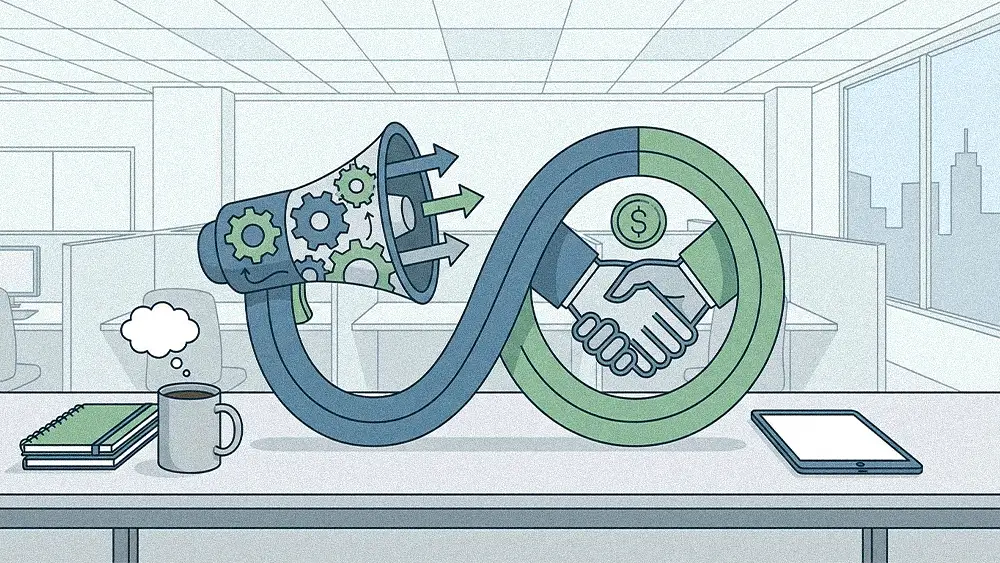
As AI continues to drive greater automation and transform customer relationships, an increasingly important differentiator becomes trust and authentic connection. In an age where many are searching for an easy button, the value of genuine, human-to-human interaction is brought into sharper focus, creating a delicate balance between AI and human touch. Nguyen describes it as a return to fundamentals. "The ones that actually show up, shake hands, and break bread will stand out. So we're kind of going full circle back to where our go-to-market was."




.webp)