
All articles
Sales and Marketing Alignment Comes Down To Shared Targets, Trust, And The SDRs In Between
Catarina Hoch, Global Head of Marketing as a Service at memoryBlue, on aligning marketing, sales, and SDRs around shared revenue accountability as automation reshapes GTM.

Sales and marketing alignment has been a conversation for years because the same issues keep coming back: misaligned targets and incentives.

Everyone assumed artificial intelligence would finally solve the sales-marketing alignment problem. Instead, for many teams, it just automated the silos. AI can route leads, draft emails, score accounts, and generate dashboards, but it can't reconcile a marketing team measured on MQLs with a sales team measured on closed revenue. Likewise, it can't rebuild trust between teams that have spent years blaming each other when the numbers are missed. Fixing the modern funnel requires a return to the cultural elements of trust through fundamental human coordination.
Catarina Hoch has lived on both sides of the divide. As the Global Head of Marketing as a Service at memoryBlue, she knows the revenue engine's pain points intimately. Before rising to VP of Global Marketing at Operatix, which was acquired by memoryBlue in 2023, she started in the tactical trenches making cold calls as a business development consultant. This understanding of the frontline reality informs her view of authentic alignment as an exercise in shared accountability and empathy rather than just a software integration.
"Sales and marketing alignment has been a conversation for years because the same issues keep coming back: misaligned targets and incentives," she asserts. The pattern is consistent enough that automation can't solve it. The fix has to start one layer up.
Misaligned incentives produce misaligned behavior
The default scorecard for marketing teams remains MQL volume, while for sales teams it's closed revenue. Because those two metrics measure different things at different points in the funnel, Hoch says the gap between them is where most of the dysfunction lives. "Marketing can influence everything, but there is often confusion of marketing being just inbound. Marketing will influence how well the brand is seen. It's also going to influence outbound. It's going to influence SDRs."
Hoch points to a friend who moved from CMO to CRO and immediately felt the metric shift change her perception of what mattered. "She said, 'Back in the day I cared about pipeline. Now I care about contract signs coming through.' Organizations would be a lot more efficient if marketing's targets were aligned to revenue rather than just MQLs." She's clear to point out that pipeline metrics aren't wrong. The issue is that they're insufficient when divorced from the closed-revenue outcome that determines whether the company actually grew. When marketing and sales chase different numbers, the credit fights become inevitable and the trust erodes.
The customer journey isn't linear, and the attribution wars show it
The second source of alignment friction is the fight for recognition that follows every closed deal. The customer journey is never as clean as the dashboard makes it look. "We often run a campaign where somebody responds to a marketing email, but the SDR has called them eight times. They might have seen your ad somewhere, heard of you on a Slack channel, had an email from your SDR, and then come inbound through a Google ad. Every single step would have helped for that person to enter your funnel," Hoch explains.
That sequence is the operating reality behind what Hoch calls the all-bound motion. The distinction between inbound and outbound, or between marketing and sales, stops being useful when the path to revenue runs through all of the aforementioned channels in whatever order a given account happens to take. "There isn't inbound or outbound, there isn't marketing or sales," she says. "Everything should be working together to achieve the same result." ABX motions work better than the alternatives partly because they replace the individual-lead frame with an account-level one. The credit question becomes less urgent when the team is collectively trying to land a defined set of accounts.
SDRs are the alignment layer
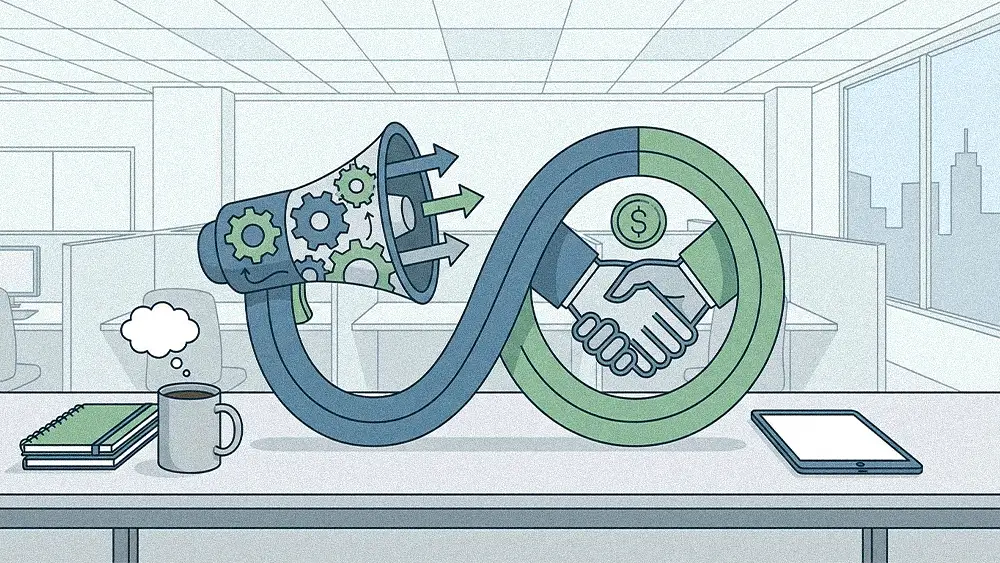
The team most often left out of alignment conversations is the one carrying the most of the actual alignment work. SDRs sit between marketing's top-of-funnel output and sales' bottom-of-funnel closes, and Hoch treats their integration into the marketing motion as non-negotiable. "SDRs are often the handshake between sales and marketing. If you think of marketing producing leads that might not be quite ready for sales yet, SDRs are that bridge. We often see clients where we just deal with their sales teams, and marketing gets no involvement with our SDR programs. We try to bring the marketing team in straight away." The integration produces measurable effect. Hoch cites data showing that cold-call conversion increases threefold when prior brand awareness exists, which makes marketing's job of warming target accounts a direct input to SDR productivity rather than a parallel workstream.
The same logic shapes how her team divides labor with UserGems, a signal-based platform that surfaces high-propensity accounts. Marketing took over email cadences entirely so SDRs could spend their time on the parts of the work that matter most. "Their valuable time should be spent on actually networking and speaking to people," Hoch says. That handoff is the practical expression of what alignment actually looks like. Marketing is making sales' job easier rather than competing for the same surface area.
AI raises the value of the human work, not the automated work
The broader market is moving in the opposite direction of the human investment that alignment requires. The pressure to automate everything is real, and Hoch sees the predictable consequence: as activity becomes commoditized, the differentiator moves to the parts of GTM that resist automation. "With a lot of AI noise out there, anything that's human will stand out. I received a handwritten letter today, with a little tea bag to say, 'Happy to have a chat over a cup of tea,'" she shares. "If that person had just emailed me or LinkedIn messaged me, I would have ignored him."
The market is responding in kind. Events, webinars, direct mail, and human-led SDR outreach are all seeing renewed investment because they create signal in a channel mix where automated touches are saturating fast. "There is a prediction that says 80% of marketing tasks will be automated in five years. What's left of that 20% is brand reputation, how you make people feel, how you impact the human side of things."
Alignment comes back to the basics
Hoch's closing argument runs back to first principles. The teams that align well are the ones whose foundations are right. "Look at the people you're going after. Is everybody talking to the same people in the same language with the same messaging? As marketers, we need to make salespeople's jobs easy."
The second foundation is communication, which she treats as the discipline that absorbs everything else. Brainstorming sessions, team meetings, and direct conversation with the SDRs running the calls are the inputs that prevent the silo problem from re-forming under any tooling stack. "It's better to over-communicate than under-communicate," she says. "SDRs are often the people having the most conversations with actual prospects. As marketers, we hide behind our systems and spreadsheets. We need to go out and speak to the people who are speaking to the customers."
The third foundation is empathy at the leadership layer, the kind that turns blame-game dynamics into honest conversation. "One CMO told me she and her CRO didn't get on at all. It was constantly a blame game. She finally asked, 'Why are you constantly blaming me for the lack of performance?' And he said, 'Honestly, I'm just scared of losing my job.' Once she put herself in his shoes, everything shifted," Hoch says. Moving forward, the teams that align in will be the ones that treat their counterparts as collaborators trying to solve the same problem, not as rivals competing for the same credit.




.webp)