
All articles
Shared Definitions Turn Two Departmental Scorecards Into One Revenue Number
Ksenia Burn, Marketing Director International at Voximplant, explains why sales and marketing reading the same CRM still reach opposite conclusions.
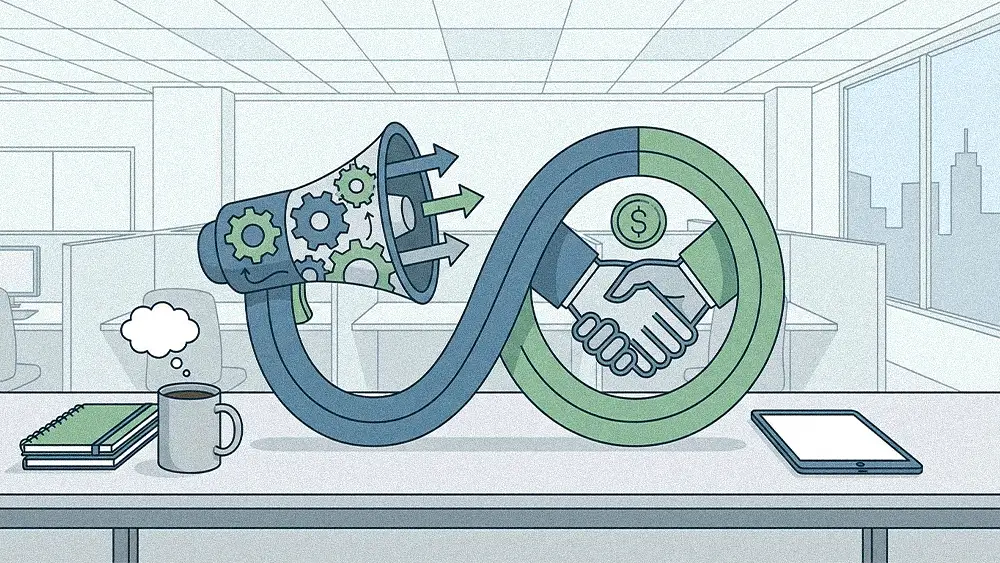
We need to stop calling this marketing and sales. It's one team, RevOps, because our target is to attract more revenue for the company.

Sales and marketing can open the same CRM and come away with different readings of the same quarter. Each team is measured on a different outcome, so each counts a different thing as progress. Marketing tracks whether the right accounts are engaging, and sales tracks whether deals close. The two teams often wind up disagreeing about what the quarter was supposed to produce, and more CRM data alone won't settle it.
Ksenia Burn is Marketing Director International at Voximplant, a cloud communications platform working across CPaaS and CCaaS. Burn has spent over a decade in product, growth and marketing leadership across SaaS, MarTech, and AdTech, including Chief Marketing Officer roles at GoComment and Checkaso. Her work has run across Europe, LATAM, the US, MENA, and APAC. Most of the problems Burn is called into begin with teams describing the same business in different terms.
"We need to stop calling this marketing and sales. It's one team, RevOps, because our target is to attract more revenue for the company," says Burn. The label is the smallest part of the change. Burn wants both functions reporting into one target and one number for the quarter. She calls what happens without it a war between the two departments, one that repeats from one company to the next.
Attribution against contribution
Burn starts every diagnosis in the CRM. Engagement quality, account coverage and stage-to-stage conversion are what she reports upward, because each one survives a follow-up question. A single clean number satisfies a board slide and collapses the moment anyone asks what moved the deal. "I start separating attribution from contribution," Burn says. "Trying to prove that one marketing touch created a deal usually gives leadership a very clear answer, but not a very honest one."
A B2B deal runs through several people at once, and the problem multiplies with each of them. A CEO, a CMO and a sales engineer can all appear on the same opportunity, each arriving with a separate question and responding to separate material. Burn builds account-level dashboards that hold every contact attached to a deal, sometimes assembled with AI, because the buying group is the unit she plans against. "One account can involve a couple of different persons," Burn explains. "We need to collect every data around the potential buyer persona and analyze what type of content they prefer, what type of goals they have."
Paid on different outcomes
Sales teams typically carry a closed-won KPI, while marketing carries volume of leads matching the target ICP. Burn points to sales teams working a funnel that begins at first contact with a rep, leaving everything upstream outside the analysis. "For sales, closed-won means achieving some money from some deals," Burn notes. "But they don't always analyze what type of person is the winner, or who attracts more revenue."
Inbound and outbound leads widen the gap further, because the two routes bring in a different kind of buyer. Marketing tunes its channels around the data it collects, sales writes outreach for the personas it expects, and each side prepares for the version it plans to meet. Burn treats the two as one pipeline regardless. "The channel can be different, but funnel is only one," Burn says. "One company, one funnel."
One dashboard, one number
In Burn's experience, a shared metric rarely survives when it comes from one single function. When a CMO defines which leads count, the sales team hears one department setting the rules for another. The same happens in reverse when sales writes the definition. Burn puts the decision a level above both, with whoever already sets budgets and targets for the two of them. "It has to be from the CEO," Burn says. "One alignment, one standard for both teams."
Burn runs a weekly session where sales and marketing work through the same accounts in the same CRM. Her team reads the records beforehand so the session starts from what happened. At some companies, she's added an AI layer that scans the week's activity and surfaces the accounts worth discussing. Doing that by hand across a full pipeline is the step that tends to get skipped when things get busy. "Every detail matters, so that's why I always say we need to use AI," Burn explains. "Because AI is really fast."
Any unsettled definition shows up when a lead changes hands. Burn wants the flow running in both directions. Sales send back what each deal taught them, in enough detail to change who marketing targets and what it says to them. The weekly session handles some of that, and a Slack thread takes the rest, with notes logged after each call and demo. "If the teams haven't agreed on what qualified means, what information sales need, how quickly they should respond, the handoff will always create friction," Burn concludes. "Sales need to return structured feedback that changes targeting, messaging and qualification."





.webp)